Salt Air and Seawater: Does the Ocean Help Your Sinuses?
Salt air has little proof behind it. Seawater sprays may ease symptoms, but ocean water is not a safe rinse. Here is what research shows and what to use.

The short version
- No study in this review tested whether breathing beach air helps sinuses, so the idea is unproven.
- In a trial of 100 children aged 6-11 with acute rhinosinusitis, a hypertonic seawater spray added to standard care eased congestion, runny nose, postnasal drip and headache, and was linked to fewer antibiotic prescriptions.
- Raw ocean water is not sterile and should never be used as a nasal rinse. Sold sprays and homemade rinses made with distilled or boiled-then-cooled water are the safer route.
- A 150-sample lab study found an average of 6.49 microplastic particles per product, ranging from 0 in syringes to 92 in nasal wash bottles.
A beach walk often feels good for a stuffy nose. Salt, moist air and a sea breeze sound like they should help. The real answer is more mixed: some seawater products have research behind them, while the ocean itself is a poor choice for rinsing.
Does breathing salt air help your sinuses?
There is no solid proof that it does. None of the studies reviewed for this guide tested sea air at the beach, so any claim that it clears sinuses is a guess.
Some people do feel better near the shore. Moist air can ease a dry, crusty nose, and a day away from dust or pollen may help too. But the amount of salt in beach air is tiny compared with what is in a nasal spray or rinse. Feeling good at the beach does not mean the salt did the work.
Sea air can also bring problems. Damp spots in rental homes, beach houses and closed-up summer rooms can grow mold. That is covered in Summer Humidity, Mold and Sinus Flare-Ups at the Shore.
Do seawater nasal sprays work?
Some do help with symptoms, at least in the one trial reviewed here. A seawater spray is not the same as breathing sea air. It delivers a measured salt solution straight into the nose.
What the children's trial found
A multicenter, randomized trial in Ukraine (Popovych and colleagues, 2024) enrolled 100 children aged 6 to 11 with acute rhinosinusitis. Some children got a hypertonic seawater spray (Aqua Maris Extra Strong) on top of standard care. The others got standard care alone. Hypertonic means saltier than the body's own fluids.
The results:
- Doctors rated runny nose, congestion, postnasal drip and headache as meaningfully better in the spray group at the second visit (p < 0.05).
- Children's own symptom scores differed from treatment day 2 (p < 0.05).
- The spray group had fewer antibiotic prescriptions.
- No side effects were seen.
The limits matter. The study was open-label, so doctors and families knew who got the spray. That can sway symptom scores. It tested one brand in children only, and it looked at short-term symptoms, not long-term sinus health. The findings do not show that other seawater products work the same way, or that adults would get the same result.
Is it safe to rinse your nose with ocean water?
No. Water straight from the ocean is not sterile. It can carry bacteria, runoff and other contaminants, and the salt level is not matched to the nose. Beach water quality also changes after storms and heavy rain.
The FDA warns that tap water is not safe for nasal rinsing either, because it can contain tiny organisms. Safe rinse water is distilled, sterile, or tap water that has been boiled for 1 minute and cooled. Details on technique are in Nasal Saline Rinses: How to Do Them Safely at Home.
If the idea is to use "natural" seawater, a sold spray or a properly mixed rinse is a far safer way to get there.
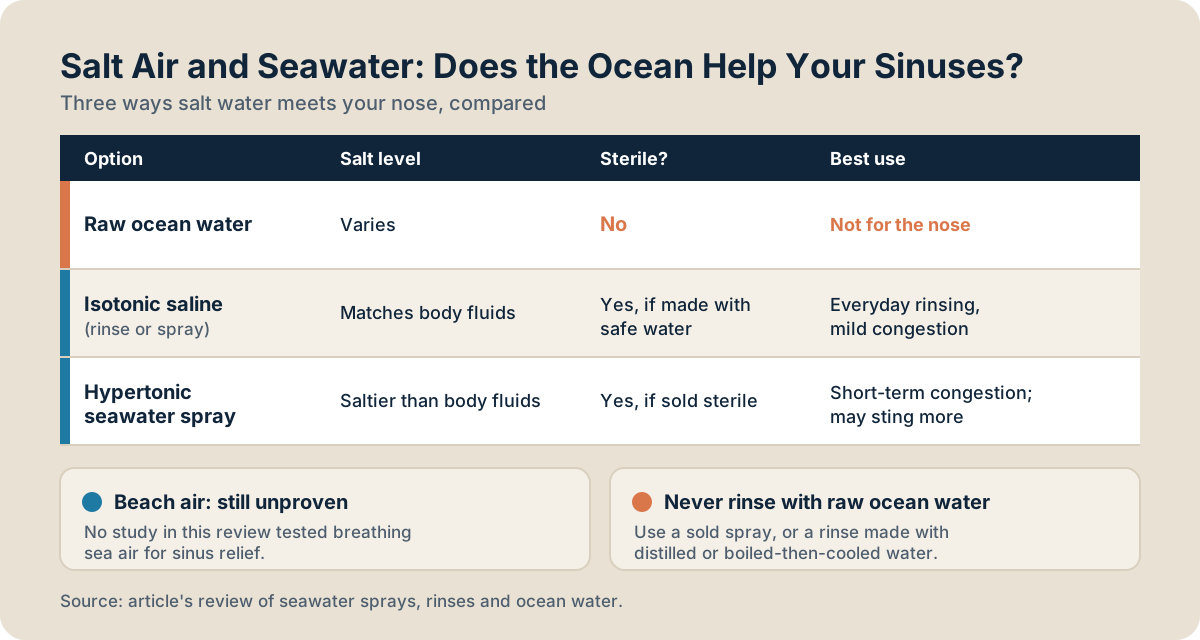
What is the difference between seawater spray, saline rinse and ocean water?
| Option | Salt level | Sterile? | Best use |
|---|---|---|---|
| Raw ocean water | Varies | No | Not for the nose |
| Isotonic saline (rinse or spray) | Matches body fluids | Yes, if made with safe water | Everyday rinsing, mild congestion |
| Hypertonic seawater spray | Saltier than body fluids | Yes, if sold sterile | Short-term congestion; may sting more |
Hypertonic products can burn or dry the nose in some people. If a spray stings, a gentler isotonic option is a reasonable switch.
Are there microplastics in nasal sprays and rinses?
Some, according to one lab study. Tuna and Taş (2025) tested 150 samples: nasal wash bottles with irrigation solution, seawater sprays, and syringes used for isotonic rinsing. They found an average of 6.49 microplastic particles per product, with wide variation. Syringes had as few as 0. Nasal wash bottles had up to 92. Exposure during a single use was highest with nasal irrigation bottles, and differed significantly between wash bottles and seawater spray brands. Syringe brands did not differ significantly from each other.
This finding should be read carefully. The study counted particles in products. It did not follow people or measure whether anyone got sick. The authors point to inflammation and oxidative stress linked to microplastics in general and call for tighter production rules. It does not show that rinsing is unsafe.
Practical takeaways:
- Keep using saline if a doctor recommended it. The benefit of clearing mucus still matters.
- Replace squeeze bottles and rinse devices on the maker's schedule.
- Wash and air-dry devices after each use.
- Do not reuse single-use items.
Can swimming in the ocean make your sinuses worse?
It can irritate them. Water that goes up the nose may sting, and some people get congestion or a runny nose afterward. Chlorinated pools can do the same.
Some simple habits help:
- Skip swimming where beach advisories or closures are posted.
- Avoid diving down or jumping in head first with a stuffy nose. Pressure changes in a blocked sinus can cause real pain.
- Blow your nose gently afterward, one side at a time.
- Rinse off at the beach shower, then use a sterile saline spray if the nose feels irritated.
Swimming does not cause a sinus infection by itself. But irritated, swollen nasal tissue can trap mucus, which makes an existing problem feel worse.
When should you see a doctor?
See a doctor if symptoms last more than 10 days without getting better, or if they improve and then suddenly get worse. Sinus symptoms that last 12 weeks or more, or keep coming back, also deserve a check. The CDC and ENT groups note that many sinus infections clear on their own, so a spray or rinse is only for comfort and is not a reason to wait on warning signs.
Get care quickly for:
- High fever
- Swelling or redness around the eyes
- Changes in vision or double vision
- Severe headache or a stiff neck
- Confusion
- Repeated nosebleeds
Children with fever and thick nasal discharge should be seen by a doctor before any decision about antibiotics, since the trial above relied on physician oversight. For shore residents whose congestion flares around beach season, mold exposure or swimming, a visit can sort out what is behind it, and you can find sinus specialists at the Jersey Shore who see these patterns often.
Common questions
Does salt air clear your sinuses?
There is no good evidence that it does. None of the studies reviewed tested beach air. Moist air may make a dry nose feel better, but the salt in sea air is a tiny amount compared with a nasal spray or rinse. Beach houses with damp rooms can also trigger symptoms.
Is seawater nasal spray good for a sinus infection?
In one randomized trial of 100 children aged 6-11 with acute rhinosinusitis, a hypertonic seawater spray added to standard care eased congestion, runny nose, postnasal drip and headache. It was open-label, used one brand and tested children only. It eases symptoms and is not a substitute for medical care.
Can I use ocean water to rinse my sinuses?
No. Ocean water is not sterile and may contain bacteria or runoff. It also does not have a controlled salt level. For rinsing, use a sold sterile saline product, or mix salt with distilled water or tap water that was boiled for 1 minute and cooled.
Are there microplastics in nasal sprays?
A 2025 lab study of 150 samples found an average of 6.49 microplastic particles per product, from 0 in syringes to 92 in nasal wash bottles. Seawater sprays were also tested. The study did not measure health effects, so it points to a manufacturing concern rather than proof of harm.
Sources
- Microplastics in different nasal irrigation options. European archives of oto-rhino-laryngology, 2025
- Multicenter, randomized, open-label, comparative study of the effectiveness of nasal spray Aqua Maris Extra Strong as a symptomatic therapy in the technology of delayed antibiotic prescription in the treatment of acute rhinosinusitis in children aged 6-11 years. American journal of otolaryngology, 2024
Trusted resources
From our sister sites
Healthy NosesNasal Irrigation for Sinus Symptoms: What the Studies ShowNasal saline irrigation may ease allergy and sinus symptoms, but the evidence is small and low quality. Here is what three studies found, and their limits.NJ Sinus & AllergyDo HEPA Air Purifiers Help Allergies? What Trials FoundHEPA air purifiers may ease some allergy symptoms, but results are mixed. Here is what two trials and a Cochrane review found, and what they miss.Articles are for general information, not medical advice. See a doctor for symptoms that are severe, last more than 10 days, or keep coming back. Last updated November 15, 2026.