Balloon Dilation vs Sinus Surgery: What the Evidence Shows
A meta-analysis of 7 studies found small differences between balloon sinus dilation and endoscopic surgery, but the evidence is limited. Here is what it means.
The short version
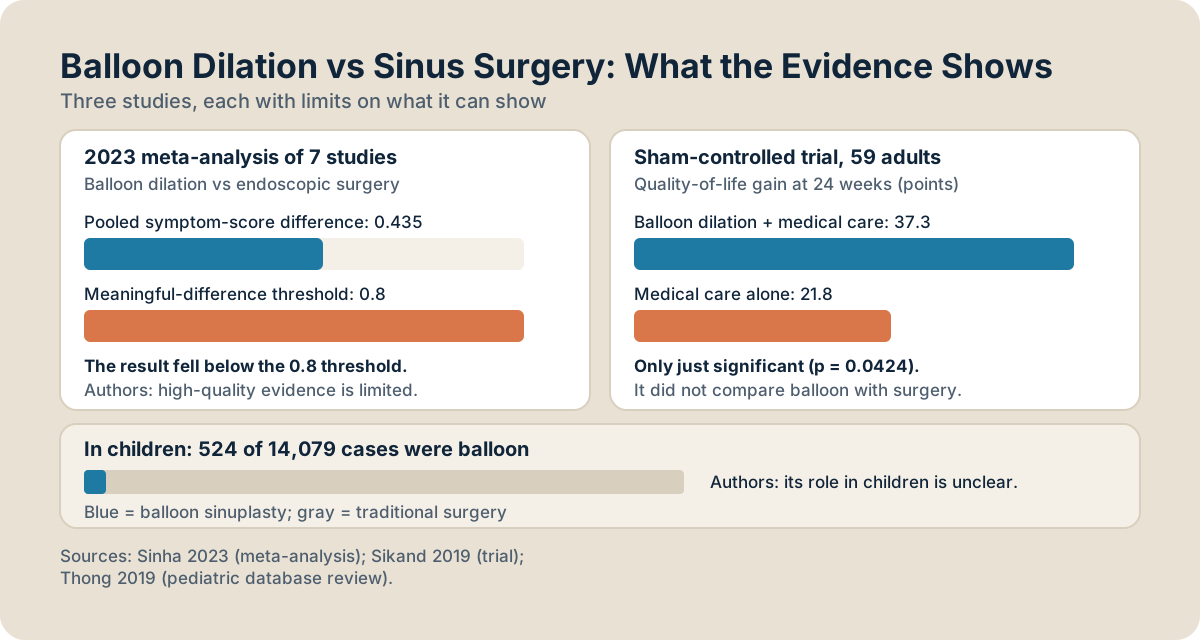
- A 2023 meta-analysis of 7 studies (4 randomized trials, 3 cohort studies) found a pooled symptom-score difference of 0.435 between balloon dilation and endoscopic surgery, below the 0.8 threshold the authors used for a meaningful difference.
- The same review concluded that high-quality evidence comparing the two procedures is limited.
- A small randomized, sham-controlled trial of 59 adults with recurrent acute sinusitis found balloon dilation plus medical care improved quality-of-life scores more than medical care alone at 24 weeks (37.3 vs 21.8 points).
- In a database of 14,079 children, balloon sinuplasty made up only 524 cases, and the authors said its role in children remains unclear.
Balloon dilation and endoscopic sinus surgery both aim to open blocked sinus drainage pathways. Many people want to know which one works better. The research gives a more cautious answer than most marketing does.
This digest looks at three studies: a meta-analysis that compared the two procedures head to head, a randomized trial of balloon dilation in people with repeated sinus infections, and a large look at how both procedures are used in children.
Is balloon sinus dilation as effective as endoscopic sinus surgery?
The best available pooled data suggest the two procedures give similar symptom changes, but the authors of that analysis said the evidence is limited. That is not the same as proof that they are equal.
How the meta-analysis was done
A 2023 paper in the Annals of Otology, Rhinology & Laryngology (Sinha and colleagues, from Washington University and the University of Virginia) pooled earlier research on chronic rhinosinusitis. A medical librarian ran the search. Two reviewers separately decided which studies to include.
The team reviewed 315 abstracts. They kept 18 studies for a qualitative review. Seven went into the numerical meta-analysis: 4 randomized clinical trials and 3 cohort studies. Each compared how much patients' scores changed on the SNOT-20, a patient-filled symptom questionnaire, after balloon dilation versus functional endoscopic sinus surgery (FESS).
What it found
Only 3 of those studies (2 trials and 1 cohort) reported the data needed for the main calculation. For those, the pooled difference in means between the procedures was 0.435. The authors compared this with a clinically meaningful difference of 0.8. The result fell below that bar.
In a second, sensitivity analysis, the team added 4 more studies. They had to estimate (impute) some missing statistics. Assuming a high correlation (0.8) between before and after scores, the pooled difference was 0.237. It was again below 0.8.
What it cannot tell us
- The authors themselves concluded there is limited high-quality evidence comparing the two procedures.
- The main analysis rested on only 3 studies. The extra analysis relied on imputed numbers.
- Cohort studies, unlike randomized trials, can differ in who got which procedure.
- The abstract does not report long-term results, complications or revision surgery rates, so this review cannot answer those questions.
The authors called for future studies that compare balloon dilation with endoscopic surgery, hybrid procedures and medical care alone, using validated objective and patient-reported measures.
Does balloon sinus dilation help people with repeated sinus infections?
One small randomized trial found that adding in-office balloon dilation to medical care improved quality of life more than medical care alone at 24 weeks. The trial was small, and the result was only just statistically significant.
How the trial was done
Sikand and colleagues published this study in International Forum of Allergy & Rhinology in 2019. It enrolled adults with recurrent acute rhinosinusitis (RARS). That means repeated short bouts of sinus infection, not constant symptoms.
Participants were randomly assigned to one of two groups:
- Balloon dilation in the office plus medical management (29 people)
- Medical management alone (30 people)
The medical-management-only group also got a sham balloon procedure. This kept everyone blind to which group they were in. Follow-up ran to 48 weeks. The main outcome was change in Chronic Sinusitis Survey (CSS) score from baseline to 24 weeks.
What it found
At 24 weeks, the CSS total score improved by 37.3 points (± 24.4, n = 26) in the balloon group and by 21.8 points (± 29.0, n = 27) in the medical-only group. The difference was statistically significant (p = 0.0424). The authors concluded that balloon dilation plus medical care was superior to medical care alone for quality of life in properly diagnosed RARS patients.
What it cannot tell us
- The trial was small. Only 53 people had 24-week scores in the analysis.
- A p-value of 0.0424 is close to the usual 0.05 cutoff. A small shift in the data could change that.
- The scores were self-reported. Sham-controlled design reduces bias, but the spread of scores was wide.
- It did not compare balloon dilation with endoscopic surgery.
- It covered adults with recurrent acute sinusitis, not people with long-lasting chronic sinusitis.
How often is balloon sinuplasty used in children?
Very rarely, compared with traditional surgery. A national database study found balloon procedures made up under 4% of pediatric sinus operations, and the authors said its role in children is unclear.
How the study was done
Thong and colleagues, from Boston Children's Hospital and Harvard, published a retrospective review in Otolaryngology–Head and Neck Surgery in 2019. They used a national pediatric database. They studied children aged 18 or younger who had balloon sinuplasty or traditional endoscopic sinus surgery (ESS). The window was 5 years before and after balloon billing codes were introduced.
What it found
| Measure | Balloon sinuplasty | Traditional ESS |
|---|---|---|
| Patients (of 14,079 total) | 524 | 13,555 |
| Median age | 6 years | 9 years |
| 30-day readmissions | 23 (4.4%) | 474 (3.5%) |
| Median cost, maxillary antrostomy | $6,560 | $5,630 |
Balloon use did not significantly increase between 2011 and 2016. The authors reported no difference in readmission rates. Balloon procedures cost more. Surgeons who did balloon procedures also did more traditional ESS than those who did not.
What it cannot tell us
This was a review of billing and hospital records. It did not measure whether children felt better, how sinus problems changed or whether anyone needed repeat surgery. It shows how procedures were used, not how well they worked. The authors said the role of balloon sinuplasty in children with chronic sinusitis remains unclear.
What does this evidence mean for someone deciding on a procedure?
The evidence does not show one procedure is clearly better. It also does not show they are identical. The studies leave real gaps.
- Balloon dilation looks roughly comparable to FESS on symptom scores in pooled data, but that rests on few studies.
- For repeated acute infections, one small trial favored balloon dilation plus medical care over medical care alone. It needs larger replication.
- Direct comparisons are scarce. Questions about long-term durability and revision rates are not answered in these studies.
- Children are a special case. Most pediatric sinus surgery in the database was traditional ESS.
Good questions to bring to a specialist:
- Which of my sinus openings are blocked, and does a scan show it?
- Have I had a full trial of medical care first?
- Why do you recommend this procedure over the other one for my anatomy?
- What are the chances I will need another procedure?
- Is a deviated septum or polyps part of my problem? Balloon dilation does not address those.
For general background on how sinusitis is diagnosed and managed, see the ENT Health sinusitis page and MedlinePlus.
When should you see a doctor about sinus symptoms?
See a doctor if sinus symptoms last more than 12 weeks, or if infections keep coming back. Do this before anyone discusses a procedure. A proper diagnosis comes first.
Get urgent care for any of these:
- Swelling, redness or pain around an eye
- Vision changes or double vision
- Severe headache with a stiff neck
- A high fever that does not settle
- Confusion or unusual sleepiness
These can signal a complication that needs fast attention.
If you want a second opinion on whether a procedure fits your case, you can find experienced sinus specialists at the Jersey Shore.
Common questions
Is balloon sinuplasty better than endoscopic sinus surgery?
Not clearly. A 2023 meta-analysis of 7 studies found a small pooled difference in symptom scores (0.435), below the 0.8 the authors used as meaningful. The authors also said high-quality evidence is limited, so neither procedure can be called better with confidence.
Does balloon sinus dilation work for recurrent sinus infections?
One randomized, sham-controlled trial of 59 adults with recurrent acute sinusitis found balloon dilation plus medical care improved quality-of-life scores more than medical care alone at 24 weeks (37.3 vs 21.8 points). The trial was small, and the result was only just significant, so larger studies are needed.
Is balloon sinuplasty used in children?
Rarely. In a database of 14,079 children who had sinus surgery, only 524 had balloon sinuplasty and 13,555 had traditional endoscopic surgery. Use did not significantly rise from 2011 to 2016. The authors said the role of balloon sinuplasty in children with chronic sinusitis remains unclear.
Do balloon sinuplasty and sinus surgery cost the same?
Not in the children's study. The median cost of balloon maxillary antrostomy was $6,560 versus $5,630 for the traditional version. That was hospital-database data on children. It does not show what adults pay or what insurance covers, so costs should be checked with your own provider.
Sources
- Balloon Sinus Dilation Versus Functional Endoscopic Sinus Surgery for Chronic Rhinosinusitis: Systematic Review and Meta-Analysis. The Annals of otology, rhinology, and laryngology, 2023
- Balloon Sinuplasty Utilization in the Pediatric Population: A National Database Perspective. Otolaryngology--head and neck surgery, 2019
- In-office balloon sinus dilation versus medical therapy for recurrent acute rhinosinusitis: a randomized, placebo-controlled study. International forum of allergy & rhinology, 2019
Trusted resources
From our sister sites
Healthy NosesNasal Irrigation for Sinus Symptoms: What the Studies ShowNasal saline irrigation may ease allergy and sinus symptoms, but the evidence is small and low quality. Here is what three studies found, and their limits.NJ Sinus & AllergyLonger Pollen Seasons in the US: What the Research ShowsResearch suggests US pollen seasons may grow longer and heavier with warming. See what three studies found and what they can't tell NJ allergy sufferers.Articles are for general information, not medical advice. See a doctor for symptoms that are severe, last more than 10 days, or keep coming back. Last updated November 13, 2026.