Chronic Sinusitis: Symptoms, Causes and the 12-Week Rule
Chronic sinusitis means sinus symptoms lasting 12 weeks or more, plus proof of inflammation. Learn the symptoms, causes, tests and treatment options.

The short version
- Chronic sinusitis means symptoms such as congestion, drainage, facial pressure or reduced smell that last more than 12 weeks.
- A diagnosis needs both symptoms and objective proof of inflammation, usually from nasal endoscopy or a CT scan.
- Estimates say chronic rhinosinusitis affects roughly 5% to more than 10% of adults, depending on how it is counted.
- In one 2024 review, 20-45% of people with chronic sinusitis also had asthma, and treatment usually starts with medicines before surgery.
Most sinus trouble clears up in a week or two. Chronic sinusitis is different. It is a long-running problem with swollen, inflamed sinus lining, and it often needs a plan made with a doctor.
This guide covers what the 12-week rule means, which symptoms count, what causes the problem, how it is diagnosed, and what treatment usually looks like.
What is chronic sinusitis?
Chronic sinusitis, also called chronic rhinosinusitis (CRS), is long-lasting inflammation of the lining of the nose and sinuses. A 2024 review describes it as a heterogeneous condition, meaning it is really a group of related problems rather than one single disease (PMID 39173076).
The key word is inflammation. The lining stays swollen and irritated, so mucus drains poorly and the nose stays stuffy or runny. It is not always an ongoing bacterial infection, which is why antibiotics are not the main treatment.
Why does the 12-week rule matter?
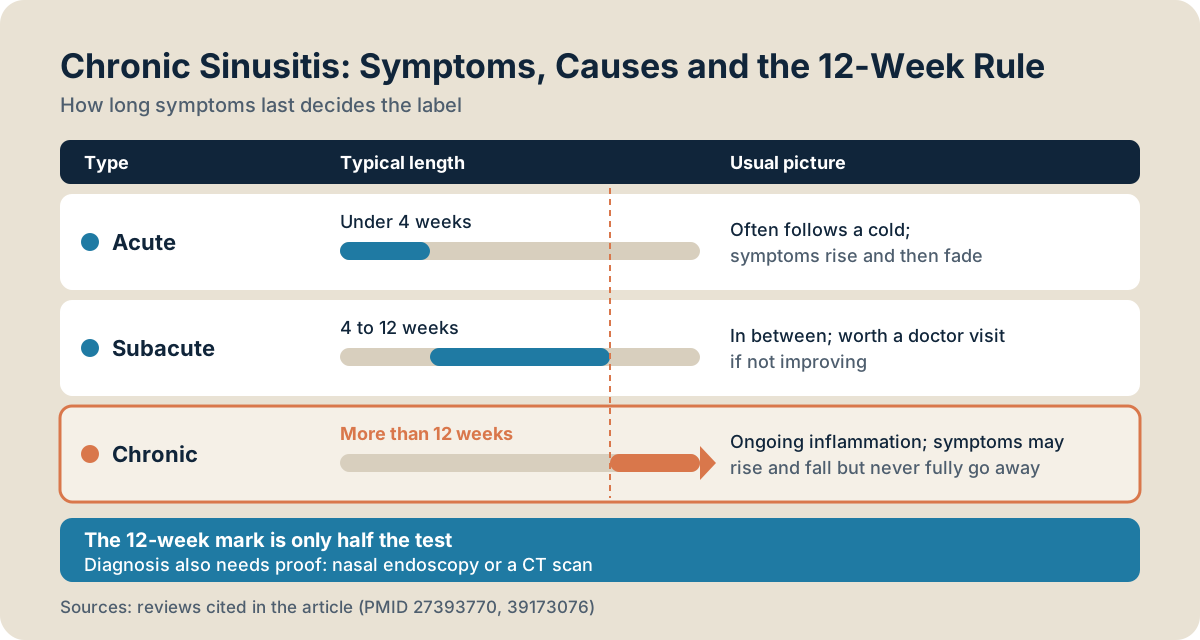
Symptoms must last more than 12 weeks to count as chronic. A review of chronic rhinosinusitis with nasal polyps uses this same cutoff (PMID 27393770).
Here is how the time frames usually compare:
| Type | Typical length | Usual picture |
|---|---|---|
| Acute sinusitis | Under 4 weeks | Often follows a cold; symptoms rise and then fade |
| Subacute sinusitis | 4 to 12 weeks | In between; worth a doctor visit if not improving |
| Chronic sinusitis | More than 12 weeks | Ongoing inflammation; symptoms may rise and fall but never fully go away |
The weeks do not need to be perfectly steady. Symptoms can flare and ease. What matters is that they never fully go away for 12 weeks or more.
For a closer look at the shorter time frames, see the site's article on how long a sinus infection lasts.
What are the symptoms of chronic sinusitis?
The main symptoms are nasal congestion, a runny nose or drainage down the throat, facial pressure or pain, and a reduced sense of smell. The reviews on CRS list these same symptoms (PMID 27393770).
In more detail:
- Blocked nose. Breathing through the nose feels hard on one or both sides.
- Runny nose or postnasal drip. Mucus comes out the front of the nose or drips down the back of the throat.
- Facial pressure or pain. It is often felt around the cheeks, eyes or forehead.
- Reduced smell. Doctors call this hyposmia. Food may taste dull.
Other common complaints include cough, tiredness and bad breath, though these are less specific to the sinuses.
One large review noted that facial pain and loss of smell are the symptoms that best separate the two main types of CRS, those with and without nasal polyps (PMID 33122665).
How common is chronic sinusitis?
It is common, but the numbers depend on how it is measured. A 2020 review says CRS occurs in more than 10% of adults in Europe and the USA (PMID 33122665). A 2024 review puts it at about 5% of the population (PMID 39173076).
The gap likely comes from definitions. Counting people who report symptoms gives a higher number. Counting only those with confirmed findings gives a lower one. Either way, millions of people live with it.
What causes chronic sinusitis?
No single cause explains every case. Researchers say the mechanisms are not fully understood. Problems with the barrier cells that line the nose, more exposure to bacteria and an overactive immune response are all thought to play roles (PMID 27393770).
The 2020 review also points to white blood cells called eosinophils and the bacterium Staphylococcus aureus as factors in why the disease persists in some people (PMID 33122665).
Things that often go along with it include:
- Asthma. In the 2024 review, 20-45% of people with CRS also had asthma (PMID 39173076).
- Allergic rhinitis. Nasal polyps are frequently linked with asthma and allergic rhinitis (PMID 27393770).
- Structural issues. A deviated septum or narrow drainage paths can make the sinuses harder to clear.
- Dental problems. A bad upper tooth can sometimes cause sinus trouble, usually on one side only.
On the Jersey Shore, damp indoor air and mold can be triggers for people who are already sensitive. They are not proven causes of CRS.
What are nasal polyps, and do they change things?
Nasal polyps are soft, painless, swollen growths of inflamed tissue inside the nose. They are typically on both sides and start in the ethmoid sinuses, between the eyes (PMID 27393770).
That review notes males are more likely to be affected than females. No specific genetic or environmental factor has been firmly linked to them so far.
Chronic sinusitis is split into two main types: with polyps (CRSwNP) and without. Polyps tend to bring more loss of smell. The types are managed a little differently, and severe polyp disease may be offered newer biologic medicines (PMID 33122665).
Is it chronic sinusitis or allergies?
They overlap, and a person can have both. Allergic rhinitis classically brings sneezing, itching, a runny nose and congestion (PMID 27545735). Chronic sinusitis is more likely to add facial pressure or pain and reduced smell, and it does not need a trigger to last.
Allergy skin tests or blood tests can confirm allergies and guide treatment (PMID 27545735). For help on the allergy side, see sinus pressure from allergies.
How is chronic sinusitis diagnosed?
Doctors need both symptoms and objective proof. The 2024 review says diagnosis combines symptoms with findings from nasal endoscopy and imaging (PMID 39173076).
- Nasal endoscopy. A thin, lighted tube lets the doctor look inside the nose for swelling, drainage or polyps.
- CT scan. This shows the sinuses and whether they are blocked or inflamed.
The proof matters because other problems, such as migraine or a dry, irritated nose, can mimic sinus pain. Symptoms alone can mislead.
What is the usual treatment?
Treatment starts with medicine and is tailored to the person. The 2024 review says CRS is treated mainly with topical steroid sprays and nasal lavage (rinsing). Short courses of oral steroids, and antibiotics where appropriate, are options in some cases (PMID 39173076).
That review reported that topical steroids improved nasal symptoms, with a standardized mean difference of -0.63. This is an effect-size measure, where a bigger negative number means a bigger drop in symptoms. Its authors describe it as a selective review of the literature, not a new trial.
If proper medical treatment does not bring enough lasting relief, endoscopic sinus surgery is the next step. The review says surgery improves individual symptoms, overall symptom scores and quality of life (PMID 39173076). Severe, stubborn polyp disease can be treated with biologic agents (PMID 39173076, PMID 33122665).
The review's conclusion is simple: CRS needs treatment adapted to the individual.
What about dryness from sprays and rinses?
Rinses, sprays and dry indoor air can leave the inside of the nose feeling dry or crusty. Some people use Narisure, a nasal moisturizer that soothes and moisturizes dry nasal passages, for that comfort issue. It is not a treatment for sinusitis.
Why does chronic sinusitis matter beyond a stuffy nose?
It affects daily life. The 2024 review says CRS markedly impairs quality of life. It also linked CRS to higher odds of some other conditions, including obstructive sleep apnea (OR 1.91), COPD (OR 1.73) and depression (HR 1.50) (PMID 39173076). These are associations, not proof that CRS causes them.
When should you see a doctor for chronic sinusitis?
See a doctor if sinus symptoms last longer than 12 weeks, keep coming back, or steadily worsen. Do not wait for the problem to "wear off."
Book a visit sooner if you notice:
- Loss of smell that does not return
- Symptoms on only one side, especially with bleeding or a one-sided blockage
- Repeated sinus infections in a year
- Symptoms despite a full course of treatment
Get urgent care right away for any of these:
- Swelling or redness around an eye
- Vision changes or double vision
- Severe headache with a stiff neck
- High fever with confusion
These can signal that an infection is spreading beyond the sinuses.
If long-lasting symptoms are wearing you down, sinus specialists at the Jersey Shore can examine your nose and sinuses and map out a plan.
Common questions
How long do symptoms have to last to be chronic sinusitis?
Symptoms must last more than 12 weeks. These include nasal congestion, a runny nose or drainage, facial pressure or pain, or reduced smell. A doctor also needs objective proof of inflammation, usually from nasal endoscopy or a CT scan, before confirming the diagnosis.
Can chronic sinusitis go away on its own?
Chronic sinusitis rarely resolves on its own because the sinus lining stays inflamed. Symptoms may ease and flare, but they usually need a medical plan. Treatment often starts with steroid nasal sprays and rinses. Surgery is considered if medicines fail to give enough lasting relief.
Is chronic sinusitis the same as allergies?
No, but they overlap and can occur together. Allergic rhinitis typically brings sneezing, itching and a runny nose. Chronic sinusitis is more likely to cause facial pressure and reduced smell, and it can persist without an allergy trigger. A doctor can test for both.
Do you always need surgery for chronic sinusitis?
No. Medical treatment comes first, usually steroid nasal sprays and nasal rinses. A 2024 review says endoscopic sinus surgery is indicated if appropriate medical treatment fails to bring adequate, sustained improvement. Severe polyp disease may also be treated with biologic medicines.
Sources
- Chronic Rhinosinusitis with Nasal Polyps. The journal of allergy and clinical immunology. In practice, 2016
- Adult chronic rhinosinusitis. Nature reviews. Disease primers, 2020
- The Diagnosis and Treatment of Chronic Rhinosinusitis. Deutsches Arzteblatt international, 2024
- Allergic Rhinitis. Primary care, 2016
Trusted resources
From our sister sites
Healthy NosesRhinitis Sicca: What a Chronically Dry Nose MeansRhinitis sicca is a long-lasting dry nose, from mild dryness to crusting. Learn the causes, how it differs from atrophic rhinitis, and when to see a doctor.NJ Sinus & AllergySinus Pressure From Allergies: Causes and What HelpsAllergies swell the nasal lining and block sinus drainage, which causes pressure. Learn why it happens, what helps, and when to see a doctor in NJ.Articles are for general information, not medical advice. See a doctor for symptoms that are severe, last more than 10 days, or keep coming back. Last updated November 11, 2026.