Summer Humidity, Mold and Sinus Flare-Ups at the Shore
Humid shore summers can feed indoor mold that irritates the nose and sinuses. Learn the signs, what studies show, and how to cut damp at home.
The short version
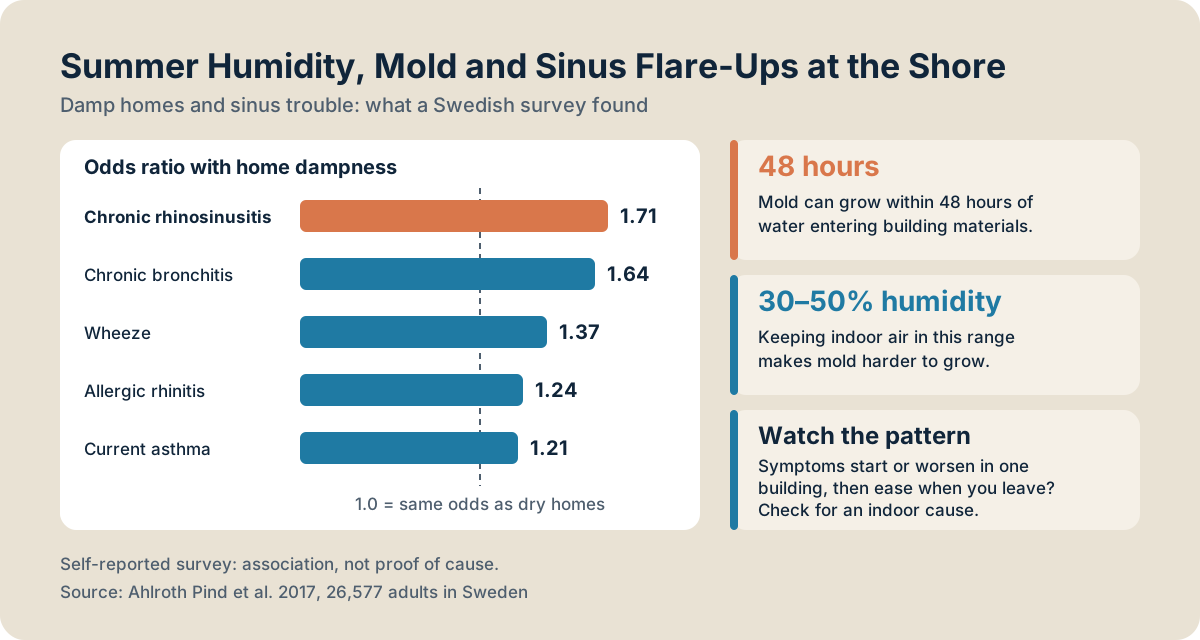
- In a Swedish survey of 26,577 adults, people who reported damp homes had 1.71 times the odds of chronic rhinosinusitis.
- Mold can grow within 48 hours of water getting into building materials, so fast drying matters.
- Keeping indoor humidity around 30 to 50 percent makes mold harder to grow.
- Nose and sinus symptoms that start or worsen in one building, then ease when you leave, point to an indoor cause worth checking.
Shore summers are warm, wet and sticky. That kind of air can make rooms damp, and damp rooms can grow mold. For some people, the first sign is a stuffy, irritated nose that never quite clears.
This guide explains how humidity and mold connect to sinus symptoms, what the research does and does not show, and what to do at home.
Can summer humidity cause sinus flare-ups?
Humid air does not directly cause a sinus infection. It can, however, help mold and dust mites thrive indoors, and those can irritate the nose and sinuses in sensitive people.
Outdoors, high humidity and warm temperatures also change what is in the air, including mold spores. Indoors, the bigger issue is usually moisture that stays put. Think of a closed-up beach house, a damp basement, or a bathroom that never fully dries.
Symptoms people commonly report include:
- A stuffy or runny nose
- Sneezing and itchy eyes
- Facial pressure
- Postnasal drip and throat clearing
- Cough or wheeze, especially at night
These overlap with allergies, colds and sinus infections. The pattern often gives the best clue. If symptoms flare in one place, such as a rental, an office or a bedroom, and ease when you leave, indoor air is a suspect.
What does research say about damp homes and chronic sinusitis?
People who report damp homes are more likely to have chronic rhinosinusitis (CRS). That is an association, not proof that dampness caused it.
A Swedish cross-sectional study (Ahlroth Pind and colleagues, 2017) analyzed questionnaires from 26,577 adults aged 16 to 75. Dampness meant reporting water damage, floor dampness or visible mold at home in the past 12 months. About 11.3% of people reported it.
After adjusting for age, social factors and smoking, dampness was linked to higher odds of several conditions:
| Condition | Odds ratio with home dampness |
|---|---|
| Chronic rhinosinusitis | 1.71 |
| Allergic rhinitis | 1.24 |
| Current asthma | 1.21 |
| Wheeze | 1.37 |
| Chronic bronchitis | 1.64 |
People who reported more than one sign of dampness had a further raised risk of CRS and most of the other conditions.
The limits matter. This was a survey, so it captures one moment in time. Dampness and symptoms were both self-reported. It cannot show that damp caused the sinus disease. Still, the size of the sample and the consistent pattern make it a useful signal.
Can nose and sinus symptoms from mold lead to asthma?
In one damp building, people with nose and sinus symptoms were more likely to develop asthma symptoms later, and heavy mold exposure raised that risk further.
Researchers from the U.S. National Institute for Occupational Safety and Health (Park and colleagues, 2012) followed occupants of a 20-story water-damaged office building through four surveys. They compared 131 people with building-related rhinosinusitis symptoms to 361 without.
The symptom group had 2.2 times the odds of later developing building-related asthma symptoms (95% confidence interval 1.3 to 3.6). Among those with higher fungal exposure in the building, the odds were 7.4 times higher (95% CI 2.8 to 19.9) than for the low-exposure group without sinus symptoms.
Limits: it was one building, symptoms came from questionnaires, and it shows association rather than cause. The authors suggested that nose and sinus symptoms in a water-damaged building may be an early warning sign for asthma. That is a good reason not to shrug off symptoms that keep coming back in a damp space.
How fast does mold grow after water gets in?
Significant mold can grow within 48 hours of water intrusion. Drying things fast is the most important step.
A 2014 review (Johanning and colleagues) looked at health hazards for people cleaning up after floods and water damage. It was based on a literature review and expert consensus at a scientific conference, not on a trial. Its main points:
- Damp building materials, especially ones made of paper or wood-based products, are prone to mold.
- Mycologists advise fixing moisture or water intrusion quickly.
- Cleaning with soap and water, removing damaged material in bulk, and then using a HEPA vacuum is recommended in most cases.
- Harsh biocides should be avoided in occupied areas.
- At a minimum, an N95 respirator should be worn for mold cleanup. Large jobs call for trained crews with proper protection.
This matters at the shore after a storm surge, a roof leak, a burst pipe or a flooded basement. Wet carpet, drywall, ceiling tiles and insulation often cannot be saved if they stay wet for days.
Where does mold hide in shore homes and rentals?
Mold favors spots that stay damp and get little airflow. These are the usual suspects:
| Place | Why it gets damp | What helps |
|---|---|---|
| Basements and crawl spaces | Humid air meets cool walls and floors | Dehumidifier, sealing leaks |
| Closed-up summer homes | No airflow for weeks | Run A/C or a dehumidifier, ventilate |
| Bathrooms | Steam and wet towels | Fan during and 20 minutes after showers |
| Window A/C units and drip pans | Condensation collects | Keep drainage clear, clean filters |
| Beach towels, bags and gear | Packed away damp | Dry fully before storing |
| Under sinks and behind walls | Slow leaks | Check for stains and musty smell |
A musty smell is a useful hint, even if no mold is visible.
How do you lower humidity and mold risk at home?
Keep indoor humidity around 30 to 50 percent, fix leaks quickly, and dry any wet material within 24 to 48 hours.
Practical steps:
- Use a small humidity meter (hygrometer). They are inexpensive and take the guesswork out.
- Run air conditioning or a dehumidifier on sticky days, and empty the tank or check the drain often.
- Use bathroom and kitchen fans, and vent dryers outdoors.
- Fix roof, plumbing and window leaks as soon as they show up.
- Clean small patches of mold on hard surfaces with soap and water. Wear an N95 mask and gloves.
- Replace the A/C filter regularly.
- Before closing up a second home, empty the fridge, prop open closet doors and remove damp items.
For large areas of mold, usually more than a few square feet, or mold after flooding, professional remediation is the safer choice. The EPA and CDC both have clear home guidance on mold cleanup.
For symptom relief from allergy-driven stuffiness, this guide on sinus pressure from allergies covers common comfort steps.
Is it mold allergy, a cold or a sinus infection?
Allergy symptoms tend to last as long as the exposure and come with itching. Infections more often bring thick discolored mucus, facial pain and sometimes fever.
- Allergy or irritation: sneezing, itchy nose and eyes, clear drainage, symptoms that follow a place or season.
- Cold: symptoms build over a few days, peak, then fade within about a week to ten days.
- Sinus infection: symptoms last more than 10 days without improving, or get worse after seeming to get better, with facial pressure and thick drainage.
One caution: you can have more than one thing at once. Nasal irritation from mold can make it harder to tell the difference.
When should you see a doctor?
See a doctor if symptoms last more than 10 days without improving, keep coming back, or interfere with sleep and daily life.
Get care promptly for:
- Fever with severe facial pain or pressure
- Symptoms that get better, then suddenly worsen
- Wheezing, chest tightness or shortness of breath
- Congestion that lasts for months
Go to urgent or emergency care right away for swelling or redness around an eye, changes in vision, double vision, a severe headache, a stiff neck, confusion, or trouble breathing.
A specialist can examine the nose and sinuses, check for allergies, polyps or chronic sinusitis, and sort out whether your home is part of the problem. For a thorough evaluation of recurring summer symptoms, New Jersey readers can consult sinus specialists at the Jersey Shore.
Common questions
Can mold in your house cause a sinus infection?
Mold itself is more often linked to irritation and allergy than to a direct infection. Still, damp homes are associated with chronic rhinosinusitis. A Swedish survey of 26,577 adults found 1.71 times the odds of CRS among people reporting dampness. That shows a link, not proof of cause.
What humidity level is best to prevent mold indoors?
Aim for about 30 to 50 percent indoor humidity, and keep it below 60 percent. A cheap hygrometer shows the number. Air conditioning, a dehumidifier and bathroom fans help. Fixing leaks matters just as much, because mold can grow within 48 hours on wet building materials.
How do you know if mold is making your sinuses worse?
Look for a pattern. Congestion, sneezing or cough that flares in one room, rental or building and eases when you leave suggests an indoor trigger. A musty smell, water stains or visible growth add to the clue. A doctor can help confirm whether allergy, infection or something else is involved.
Should you clean mold yourself?
Small patches on hard surfaces can be cleaned with soap and water while wearing an N95 mask and gloves. Large areas, mold after flooding, or mold inside walls call for trained professionals. Anyone with asthma or chronic sinus problems should avoid doing cleanup themselves.
Sources
- Rhinosinusitis and mold as risk factors for asthma symptoms in occupants of a water-damaged building. Indoor air, 2012
- Review of health hazards and prevention measures for response and recovery workers and volunteers after natural disasters, flooding, and water damage: mold and dampness. Environmental health and preventive medicine, 2014
- Patient-reported signs of dampness at home may be a risk factor for chronic rhinosinusitis: A cross-sectional study. Clinical and experimental allergy, 2017
Trusted resources
From our sister sites
Healthy NosesNasal Irrigation for Sinus Symptoms: What the Studies ShowNasal saline irrigation may ease allergy and sinus symptoms, but the evidence is small and low quality. Here is what three studies found, and their limits.NJ Sinus & AllergySinus Pressure From Allergies: Causes and What HelpsAllergies swell the nasal lining and block sinus drainage, which causes pressure. Learn why it happens, what helps, and when to see a doctor in NJ.Articles are for general information, not medical advice. See a doctor for symptoms that are severe, last more than 10 days, or keep coming back. Last updated November 7, 2026.