Balloon Sinuplasty: What It Is and Who It Helps
Balloon sinuplasty widens blocked sinus openings with a small balloon. See who may be a candidate, who is not, and what to ask before agreeing to it.

The short version
- Balloon sinuplasty uses a small inflatable balloon to widen a blocked sinus opening without cutting away tissue.
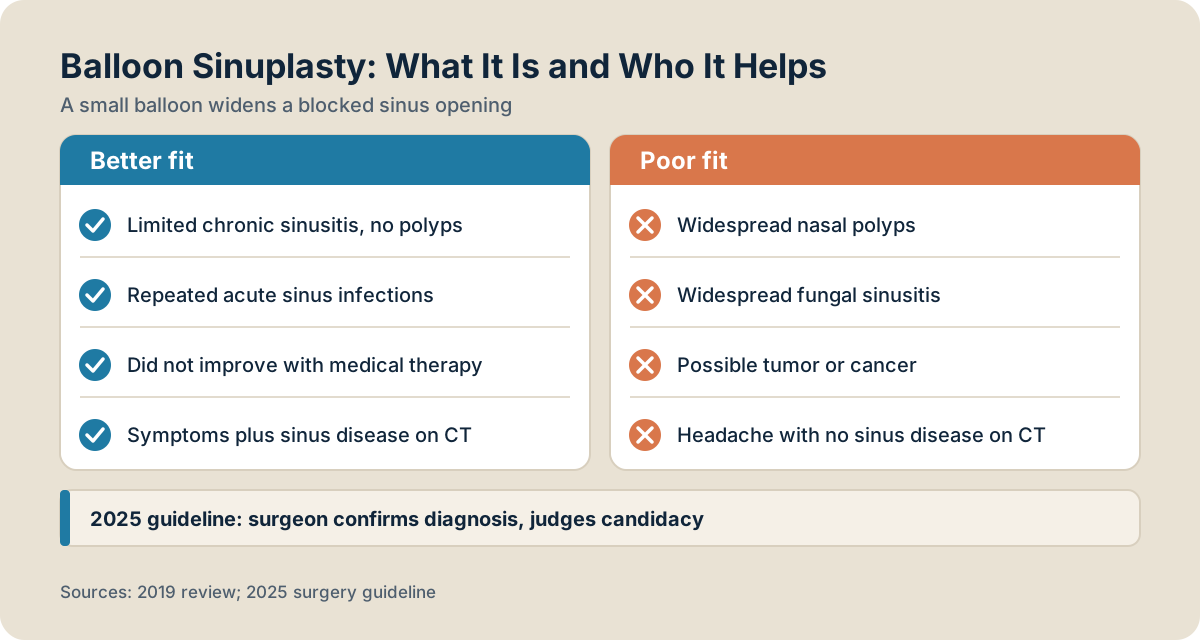
- A 2019 review found the best evidence is for limited chronic sinusitis without polyps, or repeated acute sinus infections, that did not improve with medical therapy.
- It is not suited to widespread polyps, widespread fungal sinusitis, suspected cancer, or headaches without sinus disease on a CT scan.
- A 2025 guideline says surgeons should confirm a chronic sinusitis diagnosis and judge candidacy before any sinus surgery.
Balloon sinuplasty is a procedure that opens a blocked sinus drainage passage using a tiny balloon. It is not for every stuffy nose or every sinus headache. This guide explains how it works, who tends to benefit, and who should look at other options first.
What is balloon sinuplasty?
Balloon sinuplasty, also called balloon sinus dilation, is a procedure that widens the narrow opening of a sinus so mucus can drain. A surgeon passes a thin, flexible tube with a small balloon through the nostril, inflates the balloon, then removes it.
Each sinus drains through a small opening called an ostium. When swelling or blockage closes that opening, mucus gets trapped. Trapped mucus can lead to pressure, congestion and repeat infections.
A 2019 review in Current Opinion in Otolaryngology & Head and Neck Surgery (Cingi, Bayar Muluk and Lee) describes the key idea. The balloon dilates blocked sinus openings without removing tissue. That is the main difference from traditional endoscopic sinus surgery, where tissue and bone are often removed.
How is the procedure done?
The surgeon guides a balloon catheter to the blocked opening, usually with a small camera (endoscope) in the nose. The balloon is inflated for a short time, then deflated and taken out. The opening stays wider.
The basic steps look like this:
- The nose is numbed, or the patient is put under general anesthesia, depending on the setting.
- A guide wire or catheter is placed at the sinus opening.
- The balloon is inflated to widen the opening.
- The balloon and tools are removed.
- The sinus may be rinsed to flush out trapped mucus.
The technology has changed since it was introduced. A 2017 review in Otolaryngologic Clinics of North America (D'Anza, Sindwani and Woodard) notes that the tools have gone through several generations and are easier to handle. It also describes "hybrid" procedures that pair balloons with other instruments to protect the sinus lining, including in hard-to-reach frontal sinus disease.
Can it be done in a doctor's office?
Yes, in many cases. Balloon dilation can be done in the office with local anesthesia, and that is one reason it is popular.
A 2018 review of office-based rhinology (Unsal, Gregory and Rosenstein) describes a shift. Sinus care that once required a hospital operating room has moved to outpatient surgery centers, and now increasingly to the office. Balloon dilators are one of the tools that made that shift possible.
The 2019 review adds a practical point. Office-based balloon dilation can be an option for people with other health problems who cannot safely have general anesthesia. The 2017 review also reports that multiple randomized clinical trials show improved long-term outcomes with stand-alone balloon procedures, including in-office use.
That does not mean every sinus problem belongs in an office chair. Whether the office or an operating room is right depends on which sinuses are involved and how much disease is there.
Who is a good candidate for balloon sinuplasty?
The best candidates have limited sinus disease that has not improved with medical therapy. The 2019 review found balloon dilation works best for two groups:
- People with recurrent acute sinusitis (several separate infections over a year).
- People with chronic rhinosinusitis without nasal polyps who did not respond to medical therapy.
The same review says evidence is strongest when the frontal, sphenoid and maxillary sinuses are involved. It reports that several randomized trials showed better quality of life in people with limited chronic sinusitis without polyps, in both clinic and operating room settings.
Medical therapy usually comes first. That often means steps like regular nasal irrigation and prescription sprays if a doctor advises them. Balloon sinuplasty is for when those steps are not enough.
Who should not have balloon sinuplasty?
Balloon sinuplasty is a poor fit when the problem is bigger than a narrow opening or is not in the sinuses at all. The 2019 review lists several cases where it is not suitable as the main treatment:
| Situation | Why balloon dilation is a poor fit |
|---|---|
| Widespread nasal polyps (pansinus polyposis) | The balloon widens openings but does not remove polyps |
| Widespread fungal sinusitis | Needs tissue removal and different care |
| Advanced connective tissue disorders | Listed as unsuitable as a primary option |
| Possible tumor or cancer | Needs proper diagnosis and different surgery |
| Headache without chronic or recurrent sinusitis | An expert consensus statement says it is not appropriate |
| No sinus disease on a CT scan | The same statement requires both symptoms and CT findings |
Significant disease in the ethmoid sinuses is another limit. Because the balloon only dilates openings, it is typically used for the frontal, sphenoid and maxillary sinuses. People with major ethmoid disease may have balloon dilation added to endoscopic sinus surgery instead.
A crooked septum is also a different problem. A balloon does not straighten a deviated septum. That takes a separate procedure called septoplasty.
What does a doctor check before recommending it?
A careful surgeon confirms the diagnosis first. A 2025 clinical practice guideline on surgery for chronic rhinosinusitis (Shin and colleagues, from the American Academy of Otolaryngology-Head and Neck Surgery Foundation) made two strong recommendations about this.
- Before surgery, the surgeon should verify that the patient meets established diagnostic criteria for chronic rhinosinusitis.
- The surgeon should assess candidacy based on symptoms, disease characteristics, quality of life, and prior medical or surgical therapy.
In plain terms, you should have both symptoms and proof of sinus disease, usually a CT scan, and a record of what you already tried. The guideline is aimed at adults and focuses on endoscopic sinus surgery, so it is a general standard rather than a balloon-only rule.
Is balloon sinuplasty overused?
This question is being studied. A 2026 research letter in JAMA Otolaryngology-Head & Neck Surgery (Sáenz and colleagues) looked at how often balloon sinuplasty is used after the American Academy of Otolaryngology-Head and Neck Surgery published a 2018 consensus statement on its appropriate use. The available summary describes the study design, a cross-sectional analysis, but does not give results. It would be wrong to quote numbers from it.
What it does show is that experts have written clear rules on when the procedure fits, and researchers are checking whether practice follows them. Patients can use those rules too.
Questions to ask before agreeing to it
- Do I meet the criteria for chronic sinusitis or recurrent acute sinusitis?
- Did my CT scan show sinus disease, and which sinuses?
- Which medical therapies have I tried, and for how long?
- Do I have polyps, a deviated septum or ethmoid disease that balloons will not fix?
- Would endoscopic sinus surgery or a hybrid approach fit better?
- Will it be done in the office or an operating room, and why?
- What will my insurance cover?
Shore living can add to the picture. Damp, humid summers and mold can aggravate sinus symptoms, but they do not decide whether a procedure fits. That decision rests on the scan, the symptoms and what you have already tried.
When should you see a doctor?
See a doctor if sinus symptoms last more than 12 weeks, or if you keep getting infections that clear and come back. These are the signs that a specialist exam and CT scan may be worth it.
Get care sooner for any of these:
- Facial pain or pressure with fever that lasts more than a few days or gets worse after seeming to improve.
- Swelling or redness around the eyes, or vision changes.
- A severe headache with a stiff neck.
- Bloody discharge from one side only, or a nose that stays blocked on one side.
- Symptoms that have not improved with the medical steps your doctor suggested.
Swelling around the eyes, vision changes or a stiff neck with severe headache need urgent medical care. If you are weighing a procedure like this, sinus specialists at the Jersey Shore can examine you, review a CT scan and explain which options fit your sinuses.
Common questions
Is balloon sinuplasty painful?
Most people feel pressure rather than sharp pain, because the nose is numbed with local anesthesia or the patient is under general anesthesia. Some soreness, stuffiness and drainage afterward are common. Your surgeon can explain what to expect and which pain relief is safe for you.
What is the difference between balloon sinuplasty and endoscopic sinus surgery?
Balloon sinuplasty widens a blocked sinus opening without removing tissue. Endoscopic sinus surgery often removes tissue or bone to open the sinuses. A 2019 review says balloon dilation is usually limited to the frontal, sphenoid and maxillary sinuses, while major ethmoid disease may need surgery.
Can balloon sinuplasty be done in the office?
Yes, in many cases. It can be done in an office with local anesthesia. A 2019 review says that makes it an option for people who cannot safely have general anesthesia. Whether the office is right depends on your sinuses and how much disease you have.
Does balloon sinuplasty help sinus headaches?
Only if the headaches come from chronic or recurrent sinusitis shown on a CT scan. An expert consensus statement, cited in a 2019 review, says it is not appropriate for headache that does not meet the criteria for those conditions or lacks both CT findings and sinus symptoms.
Sources
- Balloon Sinus Dilation Use. JAMA otolaryngology-- head & neck surgery, 2026
- Current indications for balloon sinuplasty. Current opinion in otolaryngology & head and neck surgery, 2019
- Innovations in Balloon Catheter Technology in Rhinology. Otolaryngologic clinics of North America, 2017
- Current opinions in office-based rhinology. Current opinion in otolaryngology & head and neck surgery, 2018
- Clinical Practice Guideline: Surgical Management of Chronic Rhinosinusitis. Otolaryngology--head and neck surgery, 2025
Trusted resources
From our sister sites
Healthy NosesNasal Irrigation for Sinus Symptoms: What the Studies ShowNasal saline irrigation may ease allergy and sinus symptoms, but the evidence is small and low quality. Here is what three studies found, and their limits.NJ Sinus & AllergySinus Pressure From Allergies: Causes and What HelpsAllergies swell the nasal lining and block sinus drainage, which causes pressure. Learn why it happens, what helps, and when to see a doctor in NJ.Articles are for general information, not medical advice. See a doctor for symptoms that are severe, last more than 10 days, or keep coming back. Last updated November 9, 2026.