Saline Irrigation for Chronic Sinusitis: What the Trials Found
Cochrane reviews of saline irrigation for chronic sinusitis found only two small trials. Here is what they showed, and what they cannot tell us.

The short version
- The Cochrane review of saline for chronic rhinosinusitis found only two trials with 116 adults in total, so the evidence is thin.
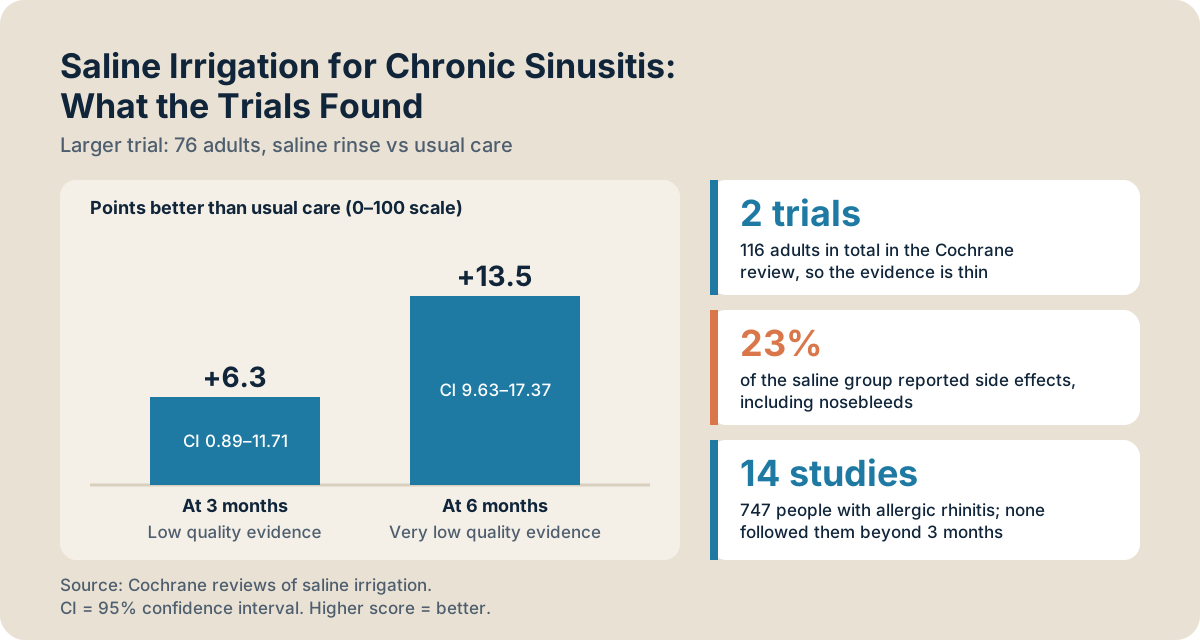
- In the larger trial (76 adults), a 150 ml hypertonic saline rinse beat usual care on a 0-100 quality-of-life scale by 6.3 points at 3 months and 13.5 points at 6 months, but the evidence was rated low to very low quality.
- In that trial, 23% of people in the saline group reported side effects, including nosebleeds.
- A separate Cochrane review in allergic rhinitis (14 studies, 747 people) found saline may improve symptoms, but no study followed people beyond three months.
Saline rinses are one of the most common suggestions for chronic sinus trouble. They are cheap and easy to try. But how strong is the proof? Two Cochrane reviews, which pool and grade randomized trials, give the clearest picture available in this set of studies.
Does saline irrigation help chronic sinusitis?
It may help a little, but the proof is thin. The Cochrane review on chronic rhinosinusitis found only two trials, and it rated the evidence for the main result as low to very low quality.
Chronic rhinosinusitis means inflammation of the lining of the nose and sinuses. It causes nasal blockage, discharge, facial pressure or pain, and a weaker sense of smell. It can happen with or without nasal polyps. A rinse is often used to ease those symptoms.
How was the Cochrane review on chronic sinusitis done?
The authors searched medical databases up to 30 October 2015. They looked for randomized controlled trials in which saline reached the nose by any method (rinse, drops, spray or nebulizer). Each trial had to compare saline with placebo, no treatment or another drug, and follow people for at least three months.
That three-month rule matters. It screens out many short studies. Only two trials qualified, with 116 adults in total.
| Feature | Trial 1 | Trial 2 |
|---|---|---|
| Saline method | 150 ml hypertonic (2%) rinse | 5 ml nebulized saline, twice a day |
| Compared with | Usual treatment | Intranasal corticosteroids (nasal steroid sprays) |
| Length | 6 months | 3 months of treatment, plus a check 3 months later |
| People | 76 adults (52 saline, 24 control), with or without polyps | The rest of the 116 adults (40) |

What did the larger trial find?
People who used the large-volume hypertonic rinse reported better quality of life than people on usual care. The gap grew over time.
The trial used the Rhinosinusitis Disability Index, scored 0 to 100, where 100 is the best quality of life. The results:
- At 3 months: the saline group scored 6.3 points better (95% confidence interval 0.89 to 11.71). The reviewers rated this evidence low quality.
- At 6 months: the saline group scored 13.5 points better (95% confidence interval 9.63 to 17.37). The reviewers rated this evidence very low quality.
The confidence interval at 3 months is wide, and its low end is close to zero. That means the true benefit could be very small. The 6-month gain looks bigger, but "very low quality" means the reviewers had little confidence in it.
The trial also measured symptom severity with a single-item question. The reviewers could not interpret it because the score range was not stated.
What about side effects?
No side-effect data were collected in the control group, so the two groups cannot be compared. In the saline group, 23% of people reported side effects, including nosebleeds. A rinse is usually gentle, but it is not free of downsides.
What does the allergic rhinitis review add?
It shows a similar pattern in a related condition. Allergic rhinitis (hay fever) is not the same as chronic sinusitis, so this is supporting context only.
The 2018 Cochrane review searched up to 23 November 2017. It included 14 randomized trials with 747 people. Seven studies were in children (499 children) and seven were in adults (248 adults). Saline volumes ranged from very low to high, and studies used either isotonic or hypertonic solutions.
For saline versus no saline, the studies used different symptom scales. The authors pooled them using a standardized mean difference (SMD). A negative number means less severe symptoms.
- Up to four weeks: SMD -1.32 (95% confidence interval -1.84 to -0.81), from 6 studies and 407 people. Low quality evidence.
- Four weeks to three months: SMD -1.44 (95% confidence interval -2.39 to -0.48). Low quality evidence is likely, but the quality rating for this result was cut off in the source text, so it is not reported here.
The review's authors said saline irrigation "may improve" patient-reported severity. Notably, no study reported results beyond three months.
What do these studies not tell us?
Several gaps limit what readers can take from this evidence.
- Very few trials. Two trials and 116 adults is a small base for chronic sinusitis.
- Old searches. The chronic sinusitis search ended in 2015. Newer trials may exist that these reviews did not capture.
- No blinding is possible with a rinse. People know whether they are rinsing, which can color self-reported scores.
- Mixed methods. The trials used different volumes, strengths and delivery devices. The findings cannot say which setup works best.
- Different conditions. Results in allergic rhinitis cannot be assumed to carry over to chronic sinusitis, and results in children may not match adults.
- No long-term data. The allergic rhinitis trials stopped at three months, and the chronic sinusitis trials at six.
- Scarce child evidence. A 2012 narrative review of chronic sinusitis in children noted that there is no general agreement on how well saline washes work.
Where does saline fit among other treatments?
It is usually a first, low-risk step, not a stand-alone answer. A 2022 review of biologic-drug trials describes the usual approach to chronic sinusitis with nasal polyps. It starts with steroid nasal sprays and saline irrigation. People who do not respond may move to short courses of oral steroids or surgery.
For severe cases, trials have tested injectable biologic drugs. One example is SYNAPSE, a randomized, double-blind, placebo-controlled phase 3 trial of mepolizumab. It ran at 93 centers in 11 countries in adults with recurrent, severe nasal polyps. That trial tested a drug, not saline, so it says nothing about rinses. It does show that doctors have other options when basic care is not enough.
How can a rinse be done more safely?
If a doctor suggests rinsing, a few safety basics apply. The FDA warns that tap water can carry germs that are harmless to drink but dangerous in the nose.
- Use distilled or sterile water, or water that was boiled and then cooled.
- Do not use untreated water from the tap, a well or the ocean.
- Wash and air-dry the device after each use, and replace it as the maker advises.
- Stop and call a doctor if rinsing causes repeated nosebleeds, pain or worsening symptoms.
For more reading on the topic, the Healthy Noses summary of nasal irrigation studies covers further research.
When should someone see a doctor?
A rinse is not a substitute for a medical exam. Book a visit if any of these apply:
- Sinus symptoms last more than 12 weeks.
- Symptoms keep coming back despite home care.
- There is a high fever, severe facial pain or swelling around the eyes.
- A sense of smell is lost or fading.
- Nosebleeds are frequent or hard to stop.
- One side of the nose stays blocked for weeks.
Seek urgent care for vision changes, a stiff neck, confusion or swelling of the forehead or eye area. Those signs can point to a serious infection.
Readers in the area can find local help through sinus specialists at the Jersey Shore, who can confirm the cause of long-lasting sinus symptoms and suggest next steps.
Common questions
Does nasal saline irrigation work for chronic sinusitis?
It may help a little. A Cochrane review found only two trials with 116 adults. In the larger one, a 150 ml hypertonic saline rinse improved quality-of-life scores by 6.3 points at three months and 13.5 at six months versus usual care. The reviewers rated the evidence low to very low quality.
Does saline irrigation have side effects?
Yes, sometimes. In the larger chronic sinusitis trial, 23% of people in the saline group reported side effects, including nosebleeds. The control group had no side-effect data, so the groups cannot be compared. Anyone with repeated nosebleeds, pain or worsening symptoms should stop rinsing and call a doctor.
What kind of water is safe for a sinus rinse?
Use distilled or sterile water, or water that was boiled and then cooled. The FDA warns that untreated tap water can contain germs that are dangerous in the nose. Ocean, well and untreated tap water should not be used. Clean and air-dry the device after every use.
Is hypertonic or isotonic saline better for a sinus rinse?
The reviewed studies cannot say. The chronic sinusitis review's larger trial used 2% hypertonic saline in a 150 ml volume. The allergic rhinitis review included both types and many volumes. Neither review identified a best strength or method, so a doctor's advice should guide the choice.
Sources
- Mepolizumab for chronic rhinosinusitis with nasal polyps (SYNAPSE): a randomised, double-blind, placebo-controlled, phase 3 trial. The Lancet. Respiratory medicine, 2021
- Saline irrigation for allergic rhinitis. The Cochrane database of systematic reviews, 2018
- Saline irrigation for chronic rhinosinusitis. The Cochrane database of systematic reviews, 2016
- Management of chronic rhinosinusitis. Pediatric allergy and immunology, 2012
- Evaluating enrollment and outcome criteria in trials of biologics for chronic rhinosinusitis with nasal polyps. Annals of allergy, asthma & immunology, 2022
Trusted resources
From our sister sites
Healthy NosesNasal Irrigation for Sinus Symptoms: What the Studies ShowNasal saline irrigation may ease allergy and sinus symptoms, but the evidence is small and low quality. Here is what three studies found, and their limits.NJ Sinus & AllergyLonger Pollen Seasons in the US: What the Research ShowsResearch suggests US pollen seasons may grow longer and heavier with warming. See what three studies found and what they can't tell NJ allergy sufferers.Articles are for general information, not medical advice. See a doctor for symptoms that are severe, last more than 10 days, or keep coming back. Last updated November 5, 2026.